- 24 July 2015
- From the section Science & Environment
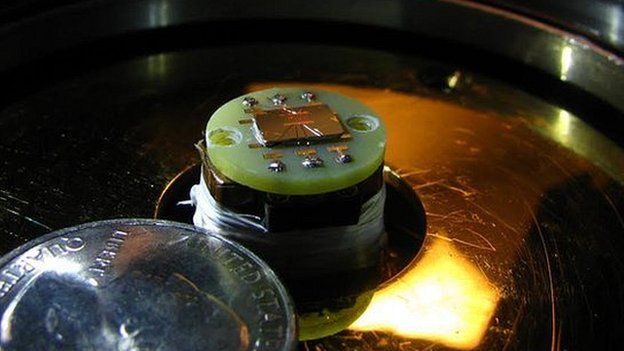
Engineers and physicists have discovered a property of silicon which could aid the development of faster computers.
Currently, copper wires transfer information in a computer; the process is slowed down as the wires heat up.
“Photonic” and “spintronic” computing is the principle of transferring information by light or electron spin.
This new property means that silicon-based light detectors identify spin, so more information can be transferred.
Spin is a property of sub-atomic particles, which influences the ordering of electrons and nuclei in atoms and molecules.
The discovered property is usually observed in materials containing heavy elements, which are difficult to integrate into existing computing systems that are composed mainly of silicon.
Silicon is a highly symmetrical crystal, but by changing the geometry of it, the team was able to impart “chiral” properties to it. Something is chiral if the mirror image of the object cannot be superimposed on the original.
This chirality means that silicon-based detectors are able to detect the spin of electrons and light, and as a result allow more information to be transmitted.
“The whole computer running with light is a distant dream, but some copper interconnectors can be replaced with light and photo-detector devices,” Professor Ritesh Agarwal, who led this study at the University of Pennsylvania, told BBC News.
“This is only around five years away from now. The technology already exists, but this can bring added functionality.”
The discovery was made by accident, while investigating heavier materials.
As well as discovering chirality in silicon, this study has wider implications for materials science.
“It’s the same silicon, all we’ve done is cut it in a particular direction,” explained Professor Ritesh Agarwal.
This is a step towards engineering new, useful properties by changing the geometry of a material.

- Frank Butler

- Frank Butler

- Frank Butler

- Frank Butler