- 4 May 2015
- From the section Africa
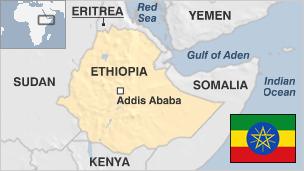
Ethiopia is Africa’s oldest independent country and its second largest in terms of population. Apart from a five-year occupation by Mussolini’s Italy, it has never been colonised.
It has a unique cultural heritage, being the home of the Ethiopian Orthodox Church – one of the oldest Christian churches – and a monarchy that ended only in the coup of 1974.
It served as a symbol of African independence throughout the colonial period, and was a founder member of the United Nations and the African base for many international organisations.
Ethiopia has suffered periodic droughts and famines that lead to a long civil conflict in the 20th Century and a border war with Eritrea.
In the first part of the 20th Century Ethiopia forged strong links with Britain, whose troops helped evict the Italians in 1941 and put Emperor Haile Selassie back on his throne. From the 1960s British influence gave way to that of the US, which in turn was supplanted by the Soviet Union.
Drought
Although it has had fewer of the coups that have plagued other African countries, Ethiopia’s turmoil has been no less devastating. Drought, famine, war and ill-conceived policies brought millions to the brink of starvation in the 1970s and 1980s.
In 1974 this helped topple Haile Selassie. His regime was replaced by a self-proclaimed Marxist junta led by Mengistu Haile Mariam under which many thousands of opponents were purged or killed, property was confiscated and defence spending spiralled.
The overthrow of the junta in 1991 saw political and economic conditions stabilise, to the extent that the country is regarded as one of Africa’s most stable.
Eritrea
Eritrea gained independence in 1993 following a referendum. Poor border demarcation developed into military conflict and full-scale war in the late 1990s in which tens of thousands of people were killed.
A fragile truce has held, but the UN says ongoing disputes over the demarcation of the border threaten peace.
Ethiopia is one of Africa’s poorest states, although it has experienced rapid economic growth since the end of the civil war. Almost two-thirds of its people are illiterate. The economy revolves around agriculture, which in turn relies on rainfall. It is one of Africa’s leading coffee producers.
Many Ethiopians depend on food aid from abroad. In 2004 the government began a drive to move more than two million people away from the arid highlands of the east in an attempt to provide a lasting solution to food shortages.
At the end of 2006 Ethiopia sent between 5,000 and 10,000 troops into Somalia to support forces of the weak transitional government there and helped to oust the Islamists who had controlled southern Somalia for six months.
But, despite initial successes, the Ethiopians were unable to break the power of the Islamists, who gradually began to win back lost territory.
Ethiopia’s presence in Somalia formally ended in early 2009, when it pulled its troops under an agreement between the transitional Somali government and moderate Islamists.

- Frank Butler

- Frank Butler

- Frank Butler

- Frank Butler