


CATEGORY
Featured
- Arts
- Ask Alma
- Ask Rusty
- Ben Chavis
- Ben Jealous
- Black Press USA
- Business
- Charlene Crowell
- Color of Law
- Common Dreams
- Community Calendar
- Corona Virus
- Courts/Law
- Crime
- Culture
- EarthTalk Q&A
- Editor Summary
- Editorial
- Education
- Entertainment
- Environment
- Faith
- Fat Mack 'n the Boyz
- Government
- Health
- Hometown Heroes
- Human Trafficking
- Immigration
- John Warren
- Julianne Malveaux
- Legal Notices
- Local & State
- Magazine
- Main
- National
- News
- Newsletter
- Op-Ed
- Oscar Blayton
- Police
- Politics
- Politics
- Quinn Minute
- Race
- Rappin' With Sandy B
- Reviews
- Reviews by Gary Roen
- Roger Caldwell
- Rusty Wright
- Screenings
- Sport
- Sports
- Style
- The Gantt Report
- The Seraaj Files
- To Be Equal
- Travel
- Veterans
- World
It Takes a Lot to Take Rogue Cops Off the Job in Colorado (MuckReads Weekly)
Some of the best #MuckReads we read this week. Want to receive these by email? Sign up to get this briefing delivered to your inbox every weekend.
Making the cut: Why choosing the right surgeon matters even more than you know (ProPublica)
Ambitious combo of shoe leather + data: @ProPublica look at surgeons' complication rates https://t.co/jEruajFW0t @marshall\_allen @olgapierce
— Margaret Sullivan (@Sulliview) July 14, 2015"...we are making public the complication rates of nearly 17,000 surgeons nationwide. Patients will be able to weigh surgeons' past performance as they make what can be a life-and-death decision. ... A small share of doctors, 11 percent, accounted for about 25 percent of the complications. Hundreds of surgeons across the country had rates double and triple the national average. Every day, surgeons with the highest complication rates in our analysis are performing operations in hospitals nationwide. Subpar performers work even at academic medical centers considered among the nation's best."
+And check out the #SurgeonScorecard database
Yemenis are terrorized by a weapon made in America, sold to the Saudis (PRI's The World)
Made in Massachusetts: A cluster bomb used near civilians in #Yemen. http://t.co/ToJSozr0WR @KenRoth #muckreads pic.twitter.com/bcEY0dTFDd
— David Beard (@dabeard) July 17, 2015"Saudi Arabia and the United Arab Emirates have spent hundreds of millions of dollars on SFWs from Textron with US government approval. When these two nations started to stockpile SFWs several years ago, each weapon cost about $360,000. This year the Saudi-led air campaign against Yemen's Houthi rebels began to use the weapon in the Houthis' home province of Saada, near the Saudi border."
Colorado laws allow rogue officers to stay in law enforcement (The Denver Post)
Colorado laws allow rogue officers to stay in law enforcement: http://t.co/otLrCxBkmU #muckreads @cosher
— Greg Griffin (@GregGriffin) July 13, 2015"Michael Jimenez resigned from the Denver police force in 2008 after he allegedly had sex with a prostitute he picked up in his squad car. But that did not stop the Custer County Sheriff's Office from hiring him in 2009. He lost that job, too, in less than a year. Then the Fowler Police Department, whose chief knew Jimenez from Denver, hired him. Jimenez never showed up for work and was later fired after pleading guilty to driving while ability impaired. Still, his certificate to work as a police officer remained active."
Tens of thousands of rape kits go untested across USA (USA Today)
An untold number of rape kits are never tested. @BySteveReilly and company show why. #MuckReads. http://t.co/IWpdl0RlOi via @usatoday
— Ray Locker (@rlocker12) July 16, 2015"New York is one of 44 states with no law stipulating when police should test rape kits and 34 states that haven't conducted a statewide inventory. 'We need to have a full accounting for the state of what's left, what hasn't been tested, why it hasn't been tested and just clear it up,' said New York State Assembly member Linda Rosenthal, a Democrat, who has introduced legislation requiring an inventory. The bill has yet to make it out of committee."
We didn't send out a #MuckReads weekly newsletter last week. So, if you missed some of those reads, here are a few we would have sent out:
Fatal extraction: Australian mining in Africa (The Center for Public Integrity and The International Consortium of Investigative Journalists)
Beautiful and powerful new project from @Publici - Australian mining in Africa - http://t.co/2KCfuJcbvN #mustread #muckreads
— Meghann Farnsworth (@mtfarnsworth) July 10, 2015"Across the continent, Australian mining companies have been implicated in deaths, cases of alleged negligence, illegal licensing, unfair dismissal, forced displacement and environmental degradation. Thousands have sued or filed grievances against these companies, their subsidiaries and subcontractors. ... Since 2004, Australian-listed companies were linked to more than 380 deaths in on-site accidents and off-site skirmishes in Africa."
Ghost students, ghost teachers, ghost schools (BuzzFeed News)
Catching up with this devastating story on how U.S.-built schools in Afghanistan are mostly a myth http://t.co/fLRCj5gxYw by @AzmatZahra
— Blake Hounshell (@blakehounshell) July 10, 2015"For Afghanistan overall, the data showed 1,174 schools — almost 1 in every 12 — was a ghost school, an educational facility that the Afghan government publicly claimed was open but that was, in fact, not operating. In the provinces that are the most dangerous to monitor — and into which the U.S. poured the most aid money — that proportion soared. In Kandahar province, where DeNenno served, a full third of the 423 schools the Ministry of Education publicly reported as open in 2011 were not functioning, and in Helmand, it was more than half."
Sign Up For the MuckReads Weekly Email

Agent Orange Act Was Supposed to Help Vietnam Veterans — But Many Still Don’t Qualify
Five decades after the Vietnam War began—and four decades after it ended— veterans exposed to the chemical brew dubbed Agent Orange are still fighting for compensation and benefits for themselves and their children.
And it turns out, not all veterans exposed to Agent Orange are being treated the same.
The fight is playing out in the halls of Congress, in courtrooms and at veterans meetings across the country.
Agent Orange is the name given to a mixture of toxins used during the Vietnam War to remove leaves from trees and bushes, leaving the enemy more exposed. (It got its name from the orange stripes on barrels containing it.)
All told, about 9 million military personnel served on active duty during the Vietnam era, but most were not stationed in the country. Of those, some 2.6 million were potentially exposed to Agent Orange, the U.S. Department of Veterans Affairs estimates.
The VA began receiving claims related to Agent Orange exposure in 1977, according to a November 2014 report from the Congressional Research Service. In 1991, Congress passed the Agent Orange Act, which said that certain diseases tied to chemical exposure would be presumed to be related to a vet's military service and would make the vet eligible for benefits. The list has grown over time and now includes various cancers, diabetes, Parkinson's Disease, peripheral neuropathy and heart disease, among others.
To get these benefits, though, veterans "must have actually set foot on Vietnamese soil or served on a craft in its rivers (also known as 'brown water veterans')," the Congressional Research Service wrote. Those who instead spent time on deep-water Navy ships (called "Blue Water Navy" veterans) do not qualify unless they can show that they spent time on Vietnam land or rivers, the report said.
Below are various groups who receive Agent Orange benefits or are seeking them.
Those Who Served in Vietnam
Since 2002, more than 650,000 veterans have been granted benefits because of their Agent Orange exposure, the VA estimates. (The department did not keep data prior to then.)
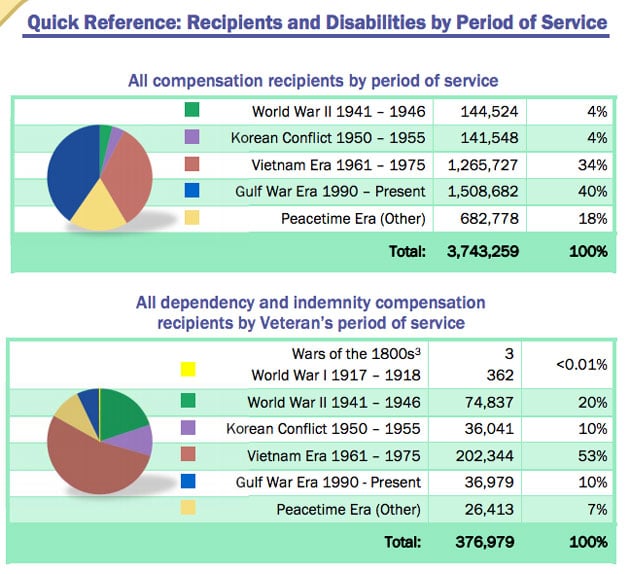
According to the VA's annual benefits report, it spent nearly $1.3 billion on compensation for Vietnam era veterans in fiscal year 2013, the most recent year for which data is available. That is about one-third of the $3.7 billion in compensation provided that year for all veterans. That figure includes monthly cash compensation payments, but not health care services.
The VA's website says that: "For the purposes of VA compensation benefits, Veterans who served anywhere in Vietnam between January 9, 1962 and May 7, 1975 are presumed to have been exposed to herbicides, as specified in the Agent Orange Act of 1991. These Veterans do not need to show that they were exposed to Agent Orange or other herbicides in order to get disability compensation for diseases related to Agent Orange exposure."
Veterans can obtain information on the VA's website, where they can also file claims for benefits.
Air Force Personnel Exposed to Contaminated C-123 Aircraft
In June, the VA expanded benefits to Air Force and Air Force Reserve personnel who served as flight, medical and ground maintenance crew members on C-123 aircraft that were used to spray Agent Orange. These troops, estimated to number between 1,500 and 2,100, will be eligible for benefits if they have a health condition from the same list that applies to on-the-ground troops.
This followed a report earlier this year from the national Institute of Medicine, which found that "some reservists quite likely experienced non-trivial increases in their risks of adverse health outcomes."
"Opening up eligibility for this deserving group of Air Force veterans and reservists is the right thing to do," VA Secretary Robert A. McDonald said in a statement in June.
Two other senators, Richard Burr, R-N.C., and Jeff Merkley, D-Ore., had long pushed the VA to provide benefits to C-123 veterans.
"The effort of these veterans to secure overdue VA care and benefits for harmful exposure to Agent Orange has not been one of the agency's finest hours," Burr said in a statement. "This frustrating, four year process has laid bare the lengths that the VA will go to disregard science and the facts of the historical record. I am pleased Secretary McDonald has chosen to finally do the right thing for these ailing veterans, but it shouldn't have been this hard or taken so long."
Blue Water Veterans
The VA does not currently provide Agent Orange benefits to an estimated 90,000 "blue water" veterans who say they were exposed to the chemical in their drinking water while working on Navy ships off the coast of Vietnam.
In 2002, a VA report found there was insufficient evidence to connect health problems of blue water sailors with chemical exposure aboard ships, establishing the basis for denying benefits to vets who didn't set foot in Vietnam. That decision was upheld by a federal appeals court in 2008. A 2011 report by the Institute of Medicine, however, identified several "plausible routes" for Agent Orange exposure through the water distillation process aboard Navy ships, as well as through the air.
Such vets can only receive Agent Orange-related benefits if they show "on a factual basis" that they were exposed to the chemicals during their military service.
Following the decision last month to grant Agent Orange benefits to C-123 crews, Sen. Kirsten Gillibrand, D-N.Y., said the VA should do the same for blue water Navy vets. Bills introduced in the Senate and House this year would extend presumptive Agent Orange health coverage to sailors who served in territorial waters as far as 12 miles from the Vietnam coast.
"We owe it to the veterans who bravely served our country and have fallen victim to Agent Orange-related disease to enact this legislation that will provide the disability compensation and healthcare benefits they have earned," Gillibrand said in a statement.
In April, the U.S. Court of Appeals for Veterans Claims struck down VA rules that denied presumptive Agent Orange compensation for sailors whose ships docked at the harbors of Da Nang, Cam Ranh Bay and Vung Tau. Those ports, the court determined, were in the Agent Orange spraying area. The VA is not appealing the ruling.
Those Who Served Elsewhere
Veterans who served in or near the Korean demilitarized zone between April 1968 and August 1971 and who have a disease associated with Agent Orange are entitled to benefits under VA rules that took effect in 2011.
The VA acknowledges that vets stationed at Air Force bases in Thailand between 1961 and 1975 may have been exposed to Agent Orange, which was sprayed along the perimeters of the installations. But those who served at bases in Thailand must prove they performed duties that may have led to exposure.
Lawyers who routinely argue on behalf of Vietnam-era veterans seeking benefits say it can be difficult to satisfy the VA's requirement for proving exposure in Thailand. For example, Army veterans must produce documentation showing their duties sent them to the outskirts of a base, either through written orders, statements from fellow veterans, or through photographic evidence, lawyers said.
Children of Veterans
For decades, Vietnam veterans have voiced concern that their Agent Orange exposure has led to health issues for their children and grandchildren. Over the past three years, Vietnam Veterans of America has recorded hundreds of testimonials from offspring of Vietnam veterans who believe their health has been affected by a parent's exposure. The VA, though, says there's insufficient research to make a scientific connection.
Despite that, the VA provides benefits for a limited number of birth defects in children of Vietnam veterans, including spina bifida for children of all vets (male and female) and 18 other health conditions solely for children of female vets. To date, about 1,200 children with spina bifida have received those benefits, along with 14 children of female veterans with other covered birth defects, according the VA.
In its most recent report to the agency, published in 2013, the Institute of Medicine concluded that "a connection between toxin exposure and effects on offspring, including developmental disruption and disease onset in later life, is biologically plausible." The report recommended further study.
Bills pending in the Senate and House would create a national research center to study medical conditions that arise in the descendants of those exposed to toxic substances during military service, not only in Vietnam, but also in the Gulf War, Afghanistan and Iraq.
"When an individual serves their country in the military, I would assume that they recognize the challenges and the sacrifices that they may make," said Sen. Jerry Moran, R-Kan., during a Committee of Veterans Affairs hearing last month. "When something happens to them, it's a terrible thing. But I cannot imagine the pain or concern that comes to a father or a mother who now sees the consequence of their military service now affecting their children or their grandchildren."
The legislation has the backing of many veterans organizations, but the VA opposes the bill. Rajiv Jain, a VA assistant deputy under secretary for health, told lawmakers last month that other federal agencies are better suited to research the effects of toxic exposure. Further, Jain testified, "a proposed center focusing solely on military toxic exposures would likely not have the statistical basis to support conclusive findings."
Are you a Vietnam veteran? ProPublica and the Virginian-Pilot are interested in hearing from veterans and family members for our ongoing investigation into the effects of Agent Orange on veterans and their children. You can help inform our reporting by completing this short, confidential questionnaire. Here's a look at just a few of the nearly 1,500 stories people have shared with us so far. Help us investigate by sharing your story now at www.propublica.org/agentorange or hamptonroads.com/agentorange.
Created with flickr slideshow.

For a Surgeon With a History of Complications, a Felony Past
Officer Richard Walter looked out the window of his patrol car and saw two young men trading punches outside Sutter’s Saloon.
It was 2 a.m. on what should have been a forgettable night shift in 1989. Sutter’s was near the State University of New York at Buffalo – a student hangout, not a rough dive. Walter, now a seasoned detective, still can’t shake the bizarre and bloody memory of that night.
The men didn’t notice the cop pull into the parking lot. Walter grabbed his baton and approached, then saw a glint of metal. One of the men held a knife, the blade protruding three inches from his clenched fist.
Instantly a geyser of blood spurted from the unarmed man’s neck onto Walter’s uniform – 10 feet away. The man collapsed, his neck slashed open “from his ear to his Adam’s apple,” Walter said, recalling what he wrote in the police report. Blood pulsed onto the pavement from his severed carotid artery and jugular vein.
Walter drew his gun and pointed it. The attacker dropped the knife and clasped his hands around his victim’s gashed neck to stanch the bleeding.
“I’m a medical student,” the attacker said. “I know what I’m doing.”
Twenty-five years later, Dr. Constantine Toumbis sat at a large conference table at Citrus Memorial Hospital in Central Florida. On the night he was arrested outside Sutter’s Saloon, his clothes and hair were splattered with blood. At the board meeting in August 2014, he wears a dark tailored suit, a crisply knotted tie, a monogrammed shirt and cuff links. His salt-and-pepper hair was neatly cropped. He jotted notes with an elegant pen.
By many measures, Toumbis’ career is a success. He’s been chief of staff at Citrus and sits on its board of trustees. He is among Florida’s busiest spinal surgeons, operating at Citrus in Inverness and also at Seven Rivers Regional Medical Center in nearby Crystal River. He earned $1.2 million just from Medicare in 2012.
But when ProPublica compared the performance of nearly 17,000 surgeons who do elective operations under Medicare, Toumbis stood out for another reason: His complication rates for routine spinal procedures were among the highest in the nation. At least two of his patients died and 44 were readmitted to the hospital with postoperative complications over five years.
When we travelled to Florida to find out more, we interviewed someone who knew Toumbis and mentioned hearing he had once been convicted of a violent crime. A Google search turned up a story from the Buffalo News headlined “Former Medical Student Gets Public Service Term.’’ It set out how Toumbis had stabbed a classmate and been found guilty of felony assault.

While Toumbis’ criminal record was not relevant to our examination of surgical complications, it did raise questions about systems for licensing and vetting doctors.
Doctors applying for state medical licenses and jobs are typically asked to disclose any criminal convictions. Records show that Toumbis omitted or misrepresented his crime and felony record when he applied for a hospital internship and in filings submitted to Florida medical regulators. In one of those records, he even portrayed himself as a victim – of an attacker who thrust his neck onto Toumbis’ dagger.
It’s unclear if both of the hospitals where Toumbis operates are aware of his past.
Citrus Memorial did not respond to questions about Toumbis’ criminal history.
Ryan Beaty, the hospital’s chief executive for about 10 years until he retired in 2014, said he didn’t know about Toumbis’ felony conviction until ProPublica told him about it. “He just doesn’t seem like that kind of guy to me,” Beaty said. “It also surprises me that I didn’t know. Somehow I missed that bit of information.”
Seven Rivers officials said Toumbis disclosed his felony conviction to them. “Dr. Toumbis further shared his unwavering determination to fulfill his career goal to become an orthopedic surgeon despite this unfortunate incident that interrupted his lifelong ambition,” Dorothy Pernu, the hospital’s director of marketing and communications, said in an email.
Toumbis, 49, declined multiple requests to answer questions about his record.
In May, a ProPublica reporter visited Toumbis’ office and left a note. Toumbis did not reply, but a Citrus County sheriff’s deputy called to say Toumbis did not want to be contacted. A week later, a notice arrived from Toumbis warning that future visits would be prosecuted as trespassing.
It began with a dispute about karate.
When Toumbis was about 12, he helped a teenage karate instructor put on demonstrations for Cub Scouts. As a reward, he received what he would eventually acknowledge in a medical school hearing was an “honorary” black belt. He acknowledged “puffing” up his medical school application by saying he was a karate instructor. He also told friends he was a black belt in the martial art.
In fact, Toumbis worried about defending himself. While an undergraduate at New York University, he bought a knife to ward off any threats. Called an Urban Skinner, it was a push dagger – designed to be held in a fist with a three-inch blade protruding outward.
Toumbis didn’t get into medical school on his first try, so he went to the SUNY at Buffalo, commonly known as University of Buffalo, for a master’s degree in natural science. There he befriended the student who would become his victim, Frank Slazyk. The two earned their degrees together, then entered the university’s medical school.
Toumbis and Slazyk socialized with the same group and studied in Toumbis’ apartment. That’s how Slazyk saw Toumbis’ black belt, which he believed to be real, and heard Toumbis’ claim that he was a karate instructor, which he believed to be true.
On Easter Sunday, March 26, 1989, Slazyk invited Toumbis to celebrate with pierogi and Polish sausage at his grandmother’s house. Toumbis couldn’t make it, so that night they went to a bar to play darts, eat chicken wings and drink beer.
According to the bartender’s statement to the police, Slazyk and Toumbis had been having a good time but got unruly late in the night. Slazyk was making karate motions and feigning punches and kicks at Toumbis, who was blocking the blows and coming back with some of his own shadow-boxing moves.
The horsing around got rowdy enough that the bartender asked them to leave, and the two walked out together. There didn’t seem to be any actual hostility between them, the bartender said. Another person at the bar told police Slazyk had apologized to Toumbis before they left.
Toumbis later claimed at his trial that Slazyk was goading him into a fight at the bar, saying, “Let’s see some of your karate.” Toumbis said that after a few blows made contact and it got heated, the bartender agreed to delay Slazyk so Toumbis could leave first. Slazyk followed and attacked him in the parking lot, Toumbis said.
Slazyk told ProPublica in an interview that Toumbis lost his temper when he saw that Slazyk hadn’t locked his car door. He said they were arguing about the door when Toumbis said, “Don’t get lippy with me. I have a black belt.”
That’s when Slazyk said the brawl began.
When other officers joined Walter outside Sutters’ Saloon, they found Toumbis trying to stop Slazyk’s hemorrhaging. His white canvas jacket and face were smeared with Slazyk’s blood.
“What happened here?” one of the cops asked.
“He’s been stabbed,” Toumbis said, according to a police report. “By me. I stabbed him. He came at me with lethal force. I have a right to protect myself.”
In subsequent accounts, however – before a medical school committee and when he applied for his hospital internship and Florida medical license – Toumbis would not admit to stabbing Slazyk. His versions of the incident would include details that were inaccurate or contradicted by other witnesses.
About two weeks after the stabbing, a committee of professors from the University at Buffalo medical school met to determine whether the two students should be expelled. According to a transcript of the meeting, Toumbis told the panel the Urban Skinner was a hunting knife he had bought at the nearby Boulevard Mall.
“It was not purchased for self-defense,” Toumbis said. “I didn’t think of it as a weapon.”
That clashes with Toumbis’ testimony under oath during his trial more than a year later, when he said he bought the knife in New York City to frighten off would-be attackers.
Toumbis told the medical school committee that he pulled the knife to scare Slazyk, but that his friend “moved his neck in the way” and “rushed into it,” according to the meeting transcript.
Toumbis argued that he should be allowed to continue his studies because it was a tragic accident. He added that he saved Slazyk’s life by stopping the bleeding.
The medical school expelled Toumbis. He enrolled in a doctoral program at the same university and obtained a Ph.D. in experimental pathology in 1993. The school declined to comment for this story.
At his two-week trial in November 1990, Toumbis testified that he had intended to scare Slazyk, held the knife in front of him and said, “Stay the hell away from me.” Walter, the police officer who witnessed the stabbing, testified that he did not hear Toumbis say anything to Slazyk before he stabbed him.
Toumbis testified that he never intended any harm and that he would have to live the rest of his life knowing that “the instrument that I held in my hand was the cause of almost taking a life.”


The jury convicted Toumbis of second-degree assault, which New York State law defines as recklessly causing serious physical injury to another person with a deadly weapon.
Toumbis called several character witnesses who pleaded with the judge not to send him to prison. His mother, Evelyn Toumbis, sent a letter saying the health of her husband began deteriorating the day of their son’s arrest. The dream Toumbis’s father had of his son becoming a doctor had “suddenly vanished.”
“I can say to you honestly, Judge Drury, that my husband died of a broken heart,” Evelyn Toumbis wrote.
At the sentencing hearing, the judge chastised Toumbis for not being truthful about the stabbing. The Urban Skinner dagger he used to cut Slazyk’s throat was not a hunting knife upon which Slazyk had accidentally been impaled. “It’s a vicious street weapon” the judge said.
He added: “You impaled yourself on this – on your own testimony and led to your conviction.”
Toumbis was sentenced to probation and 2,000 hours of community service.
Toumbis was accepted into the Wayne State University Medical School in Detroit in 1994. Documents on file in Florida show that an official at Wayne State later told the Florida Department of Health that the school reviewed “the incident at Buffalo,” spoke to the judge and interviewed Toumbis before deciding “that he would make a good physician.”
In May 1998, Toumbis applied for a surgical internship at the University of Florida Health Science Center in Jacksonville, according to documents on file with the Florida Department of Health.
The application asked if he had ever been convicted of a felony. In the sworn statement, Toumbis answered “No.” He was accepted into the internship program.
On the application for his United States Medical Licensing Examination, Toumbis was asked to list all medical schools he had attended, “whether completed, or not.” He did not list the University of Buffalo Medical School, which had expelled him.
Toumbis did acknowledge a felony conviction and medical school expulsion on his Florida medical license application. The statement he attached casts the stabbing as a matter of self-defense.
The statement says he went for a late-night snack at a restaurant and encountered another medical student who became hostile and aggressive. Toumbis alleged he asked a restaurant employee to detain the student, but as Toumbis went to his car, the statement says, the student threatened him.
“In an effort to deter any further aggression, I displayed a small knife which I legally possessed,” Toumbis wrote in the statement. “Undeterred, my assailant lunged at me and was cut. Bearing no personal animus against my attacker, I immediately rendered first aid.”
Elsewhere in the statement, Toumbis describes the Urban Skinner as a “pocket knife.”
Mara Burger, a spokeswoman with the Florida Department of Health, confirmed that Toumbis did not disclose his felony on his internship application, and that his U.S. medical licensing exam application did not list the medical school that expelled him.
Whether the committee that approved his license noticed the discrepancies is unknown, she said. Although the department reviewed the court documents Toumbis provided when he applied for his license, it did not do any further investigation to determine the nature of the crime, she said.
The state’s file contains several recommendations from Toumbis’ supporters. A professor from SUNY Buffalo praised Toumbis for his diligence, hard work, intellectual excellence and medical competence. “I believe he is of good character and well motivated to combine research, teaching and clinical service in academic medicine.”
But Dr. J.J. Tepas III, director of the general surgery residency program at the University of Florida Health Science Center, rated Toumbis low on most of the categories measured: medical knowledge, teaching ability, fitness for clinical practice, motivation, initiative, responsibility and integrity. Tepas declined to comment for this story.
In a follow-up letter, Tepas reiterated his negative assessment, saying he had observed Toumbis in practice on many occasions. “I have been consistently impressed by his obvious lack of interest in some of the very basic tenets of bedside clinical care,” Tepas wrote.
In his trailer home near Buffalo in August, Slazyk, 51, sat at the kitchen table drinking coffee and chain smoking Seneca cigarettes. There’s no missing the faded, jagged lines of the scar on his neck.
Slazyk’s left eyelid permanently droops – a result of a stroke from losing so much blood the night he was stabbed, he said. Words come out raspy because his voice box was torn.
Slazyk had grown up in a poor neighborhood of Buffalo called Black Rock. Medical school was supposed to be his ticket out. His dream was to become a surgeon specializing in cancers affecting women, he said.

But Slazyk never really recovered from the stabbing. He went back to medical school but was too traumatized to continue. That contributed to the alcoholism that sent him into a tailspin, he said.
The stabbing “knocked me off the track” in medical school, Slazyk said. “I was doing fine until then. Then after that, even being the victim, they put me on leave for a year-and-a-half. I was punished.”
A couple of years ago, Slazyk learned that Toumbis had become a successful surgeon. He said he had an attorney contact him and they reached a confidential financial settlement.
Today, Slazyk does not work because of his manic depression and anxiety. His wife works as a housekeeper and he gets $730 a month in Social Security income. His medical school loans were expunged because of his disability, he said.
ProPublica made many attempts to speak to Toumbis.
After the Citrus Memorial meeting in August, a reporter approached him for an interview.
“Oh – little old me?” the surgeon said. “I don’t grant interviews. You’ll have to call the hospital public relations department.”
Walter, the cop who saw the stabbing, was stunned to find out that Toumbis is a prominent surgeon.
Recalling that night at Sutter’s, he said Toumbis chose to engage in the fight. One detail in particular stuck: Toumbis’ eyeglasses were folded and placed on the hood of the car, he said, which seemed inconsistent with portrayals of being attacked by Slazyk.
Walter told ProPublica that he did not see how Toumbis could justify the stabbing. Had he wanted, he could have run away or fled back into the bar.
“I’d just love to know how a guy who’s convicted of a crime like that can be a doctor,” Walter said.
Help inform and guide our reporting on patient safety by telling us about your own experiences. Complete the questionnaire.

