


AUTHOR NAME
Red Cross Holds a Press Conference In Haiti. It Doesn’t Go Well.
Haitian journalists grilled an American Red Cross official Wednesday about the group’s Haiti program, but the official declined to provide any new details of how it spent nearly $500 million donated after the 2010 earthquake.
The Red Cross called a press conference, held at the Le Plaza Hotel in downtown Port-Au-Prince, in response to ProPublica and NPR’s story published last week revealing a string of Red Cross failures in Haiti.
The American Red Cross official at the press conference was repeatedly interrupted by Haitian reporters frustrated that he would not give specifics on its spending:
The official, Walker Dauphin, criticized our story for making “misleading allegations” and said that “in total, more than a hundred projects were implemented.”
But Haiti’s most prominent newspaper, Le Nouvelliste, wrote that Dauphin was merely “retracing the broad strokes of the interventions and expenses … while avoiding going into detail.” The paper ran the story on its front page under the headline, “When the Red Cross drowns the fish,” a reference to sidestepping a touchy subject.
Jean-Max Bellerive, who was prime minister of Haiti when the earthquake hit, also publicly criticized the American Red Cross, telling Le Nouvelliste that the Haitian government must “take legal actions to demand accountability.”
In the United States, Rep. Rick Nolan, D-Minn., has called for the House oversight committee to hold hearings on the Red Cross’ Haiti program. The story has also prompted anger and calls for investigation in a number of states. Watch this video where an activist and Georgia state senator interrupt a Red Cross spokesman: “They do not deny anything that’s been said and just direct you to some website,” said Sen. Vincent Fort.
Red Cross spokeswoman Jana Sweeney said in a statement: “The Red Cross is happy to talk with any member of Congress who has questions about our relief work in Haiti, or elsewhere.”
Annie Waldman contributed to this story.

Left in the Brain: Potentially Toxic Residue from MRI Drugs
With a family history of breast cancer, Marcie Jacobs decided in June 2001 that an MRI screening was her best preventive option.
As is common with MRIs, Jacobs was injected beforehand with a contrast agent, a drug that helps sharpen the resulting images. But after a few of these treatments, she began noticing some strange cognitive effects. Jacobs began missing meetings. Over the next several years she had additional MRIs. The math skills that were crucial to her job as finance manager started deteriorating, she said.
Jacobs eventually wound up on disability. She stopped worrying about cancer – and started worrying about imaging drugs.
This month, two prominent experts in the radiology community joined in the concern, calling for more research into the possible health risks after three recent studies found that gadolinium, a potentially toxic metal, wound up in the brain tissue of MRI patients who used two different contrast agents.
Editorializing in the journal “Radiology,” Dr. Emanuel Kanal at the University of Pittsburgh Medical Center, and Michael Tweedle at Ohio State University, said the studies “called into question” the “safety of at least some” of these agents. The two urged radiologists to change their prescribing habits, although not to stop using the drugs because of their proven benefits to patients. (Related video.)
Nine gadolinium-based contrast agents are sold in the United States. The two in question, Omniscan, made by GE Healthcare, and Magnevist, manufactured by Bayer HealthCare, once dominated the contrast agent market. Both GE and Bayer, in statements, said they were monitoring the issue and noted the new studies had not found any clinical impact, such as brain injury.
As ProPublica has reported, contrast agents like Omniscan had been on the market for years when, in 2006, they were linked to a crippling, sometimes fatal condition called nephrogenic systemic fibrosis, or NSF. The Food and Drug Administration put a “black box” warning on the drugs the following year, saying patients with kidney impairment may be at risk of NSF because they were unable to excrete the gadolinium.
ProPublica first disclosed in 2009 that the agency ignored two of its own medical reviewers who wanted to ban Omniscan for patients with severe kidney disease. In 2010, the FDA did act, recommending that GE’s drug and two other agents shouldn’t be used in patients with impaired kidneys. The other drugs were Magnevist and Optimark, sold by Mallinckrodt Pharmaceuticals.
The new studies cited by Kanal and Tweedle have set off alarms because they show that even patients with healthy kidneys are retaining gadolinium from Omniscan and Magnevist. Estimates are that about one-third of the 20 million MRIs in the United States each year use one of the nine contrast agents.
Doctors now routinely screen MRI patients for kidney problems before injecting them with contrast agents, and scientists believe that NSF has essentially disappeared. The new studies don’t speak to the clinical effects, if any, of gadolinium in the brain. But in an interview, Kanal said the findings ought to make radiologists think twice about which agents to prescribe.
“We can use an agent today that does not retain gadolinium in the brain to the degree that those other agents do,” he said, referring to Omniscan and Magnevist. Given that the alternatives are “at least as efficacious” as the other two, he asked, “Why are some still prescribing the agents that do accumulate in the brain over the other options?”
Jacobs has no medical proof, but she’s convinced the two drugs are behind her problems.
As her symptoms worsened, Jacobs said she underwent a series of tests that found accumulated traces of gadolinium in her breast, thigh, liver and brain. Doctors were puzzled because she had no history of kidney disease and did not fit into the identified at-risk group.
She recovered old records and determined that she received Omniscan for her first 11 imagings and Magnevist before the last, in 2007. Jacobs said she eventually began a difficult, extended program to remove gadolinium from her body.
Researching on the Internet, Jacobs found a support group around the issue. Then in March, a radiology journal, Health Imaging, featured the group in an article on the new gadolinium research. That same month Jacobs started a Facebook group that is now composed of researchers as well as dozens of patients with similar gadolinium experiences and no evidence of kidney disease.
Jacobs said the new studies “confirm that the linear gadolinium-based contrasting agents such as GE’s product Omniscan and Bayer’s product Magnevist are being retained at much higher levels than radiologists and the FDA have acknowledged.”
She hopes the FDA might pull the two agents from the market.
In a statement, an FDA spokesperson said the agency is “carefully reviewing” the new studies to “better understand the potential consequences to determine what further action is needed, which may include taking steps to ensure the public is aware of these preliminary findings.”
Kanal, who has been advising the FDA and also chairs the American Board of MR Safety, said the new studies have “the entire international radiological community – and the FDA – on edge, as this is an entirely unanticipated finding.”
GE Healthcare told ProPublica that as part of its commitment to safety a new company internal task force reviewed the studies and other data and continues its work.
After finding “no signs or symptoms of potential injury to the brain” associated with Omniscan and “no evidence of cytotoxicity (cell toxicity) in published autopsy studies” the task force concluded that “continued use of Omniscan according to approved product labeling” is appropriate, GE said.
Bayer told ProPublica patient safety is its “primary concern” and said it had reached out to the authors of the original research studies “to clarify their findings,” even though “none of these studies indicate any clinical implications.” The company said it was continuing to monitor the situation.
GE and Bayer have confidentially settled hundreds of lawsuits – many involving deaths – while denying liability for their contrast agents.
In 2013, one case went to trial in Cleveland and resulted in a $5 million verdict against GE. A federal appeals court upheld the verdict last year. By then the plaintiff, who had NSF, had died.
The contours of the contrast agent market have changed in recent years. Both Magnevist, once the leading agent, and Omniscan, also a top seller, have lost market share since the FDA restrictions in 2010. GE said its market share was about 10 percent last year; Bayer declined to cite a figure.
Read more reporting on drug safety by senior reporter Jeff Gerth.

What Happens When Millions Donated For Disaster Relief Goes Unaccounted For?

See the full Reddit chat here.
The American Red Cross raised nearly half a billion dollars following the devastating earthquake in Haiti in 2010 — far more than any other charity providing relief. Internally, the disaster was seen as "a spectacular fundraising opportunity."
But on the ground in Haiti, the Red Cross effort was marked by a string of failures. A ProPublica and NPR investigation uncovered confidential memos, emails from top officers, and accounts of a dozen insiders that show how the charity broke promises, squandered donations, and made dubious claims of success. For instance, the charity claimed it provided homes to more than 130,000 Haitians. They didn't. They built only six permanent homes.
So where did a half billion dollars in donations go? What relief has the Red Cross managed and how have Haitians benefited? What recourse is there for unfinished work or unanswered questions?
The discussion included community organizer and political science professor Francois Pierre-Louis, Haiti aid expert Jake Johnston, as well as ProPublica reporter Justin Elliott and NPR reporter Laura Sullivan.
New to Reddit? Click here to create an account, check out this beginner's guide from Mashable Reddit's official FAQ.
Related stories: For more, read How the Red Cross Raised Half a Billion Dollars for Haiti and Built Six Homes and our other Red Cross coverage.

One Nation, Under Sedation: Medicare Paid for Nearly 40 Million Tranquilizer Prescriptions in 2013
This story was co-published with the Boston Globe, the Miami Herald and Health News Florida.
In 2012, Medicare’s massive prescription drug program didn’t spend a penny on popular tranquilizers such as Valium, Xanax and Ativan.
The following year, it doled out more than $377 million for the drugs.
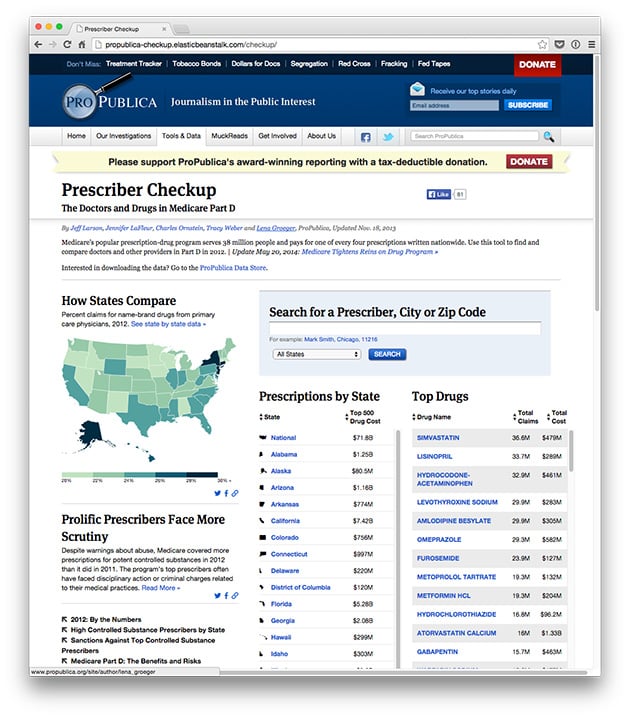
The Doctors and Drugs in Medicare Part D
Our Prescriber Checkup tool has been updated with 2013 data from Medicare, including controlled substance prescribing for each provider. Explore the app
While it might appear that an epidemic of anxiety swept the nation’s Medicare enrollees, the spike actually reflects a failed policy initiative by Congress.
More than a decade ago, when lawmakers created Medicare’s drug program, called Part D, they decided not to pay for anti-anxiety medications. Some of these drugs, known as benzodiazepines, had been linked to abuse and an increased risk of falls and fractures among the elderly, who make up most of the Medicare population.
But doctors didn’t stop prescribing the drugs to Medicare enrollees. Patients just found other ways to pay for them. When Congress later reversed the payment policy under pressure from patient groups and medical societies, it swiftly became clear that a huge swath of Medicare’s patients were already using the drugs despite the lack of coverage.
In 2013, the year Medicare started covering benzodiazepines, it paid for nearly 40 million prescriptions, a ProPublica analysis of recently released federal data shows. Generic versions of the drugs — alprazolam (which goes by the trade name of Xanax), lorazepam (Ativan) and clonazepam (Klonopin) — were among the top 32 most-prescribed medications in Medicare Part D that year.
And it appears these were not new prescriptions.
IMS Health, a healthcare analytics company that tracks drug sales nationwide, logged only a tiny increase in all benzodiazepine prescriptions, including those covered by Medicare, from 2012 to 2013. That probably means Medicare paid mostly for refills of existing prescriptions, said Michael Kleinrock, director of research for the IMS Institute.
That millions of seniors are taking Xanax, Ativan and other tranquilizers represents a very real safety concern, said Dr. Brent Forester, a geriatric psychiatrist at Harvard-affiliated McLean Hospital in Belmont, Mass.
The drugs are popular because they are fast-acting — working quickly, for example, to quell debilitating panic attacks. But they can be habit-forming and disorienting and their effects last longer in older patients. For that reason, the American Geriatrics Society discourages their use in seniors for agitation, insomnia or delirium. The group says they may be appropriate to treat seizure disorders, severe anxiety, withdrawal and in end-of-life care.
Forester said he and others who specialize in geriatric psychiatry don’t use benzodiazepines as a “first-, second- or third-line treatment because we see more of the downside than the good side.”
Some geriatric psychiatrists worry that doctors may have turned to the drugs in place of antipsychotic medications to sedate patients with conditions such as dementia. In the past several years, Medicare has pushed to reduce the use of antipsychotics, particularly in nursing homes, because of strong warnings about their risks.
In 2013, Medicare covered more prescriptions for benzodiazepines than for antipsychotics.
“At the end of the day,” Forester said, “in terms of risk, the risk with benzodiazepines seems so much worse to me … There’s significant danger and there’s no spotlight.”
A spokeswoman at the Centers for Medicare and Medicaid Services declined to answer questions about Medicare’s suddenly soaring tab for benzodiazepines.
Some doctors who ranked among Medicare’s top prescribers of the drugs said any risks were outweighed by their benefits.
Fall River, Mass., psychiatrist Claude Curran wrote more than 11,700 prescriptions for benzodiazepines (including refills) in 2013, ranking him behind only four other doctors, all from Puerto Rico. He said the drugs worked well for his patients, many of whom are trying to kick addictions to narcotics but struggle with anxiety and depression.
“First of all, they’re reliable,” he said. “Second of all, they’re cheap because they’re all generic … They tickle the brain in the same way alcohol does.”
Without benzodiazepines, he added, patients in recovery often need higher doses of methadone, which carries significant risks of its own. “Anyone who’s ever had a panic attack is sympathetic to the use of the benzos,” Curran said. “Anyone who has never had a panic attack doesn’t understand it.”
Medicare Part D Totals by the Numbers, 2013
Notes: Counts include initial prescriptions and refills dispensed. Retail price includes patients’ out-of-pocket costs but does not reflect drug maker rebates. Average prescriptions per patient, per provider has been adjusted to give more weight to doctors who treat more patients. (The unadjusted average is 5.7).
The vast majority of Curran’s Medicare patients were younger than 65 and qualified for coverage based on a disability. Disabled patients made up about a quarter of Part D’s 35 million enrollees in 2013, but used benzodiazepines disproportionately, accounting for about half of all prescriptions.
Miami psychiatrist Rigoberto Rodriguez also ranked high among Medicare prescribers of benzodiazepines, writing 9,900 prescriptions in 2013, but most of his patients were seniors. Many, he said, are Cuban immigrants who experienced traumas that left them with lingering anxiety, and they have been taking the drugs for years.
Rodriguez readily acknowledged the risks of the drugs for elderly users — recently, researchers found that the longer a person took benzodiazepines, the higher his or her risk of being diagnosed with Alzheimer’s Disease. The drugs’ labels say they are generally for short-term use but many patients take them for years.
Rodriguez said he has been working to reduce his benzodiazepine prescriptions in light of emerging research. He expects that when Medicare releases data for 2014 and 2015, his totals will be lower.
Prescribing Benzodiazepines and Narcotics
Below are the states with the most doctors who prescribed at least 1,000 prescriptions of both benzodiazepines and narcotics. Experts say combining the two increase the risk of overdoses.
| State | # of Doctors |
|---|---|
| FL | 158 |
| AL | 136 |
| KY | 102 |
| TN | 84 |
| TX | 71 |
| GA | 71 |
| NC | 60 |
| CA | 49 |
| OH | 49 |
| VA | 45 |
“This is fresh information coming out in the last couple years … telling us that benzos are probably not good and you should try to avoid them,” Rodriguez said. “I totally agree with that.”
Roberto Hernando, another Miami psychiatrist who wrote high numbers of benzodiazepine prescriptions in 2013, said he intends to review his prescribing after a reporter told him his totals.
“Some people may need it; some people may not,” he said. “You’re bringing to my attention something that I wasn’t even aware of.”
When Congress created Medicare’s drug program in 2003, there wasn’t much discussion about whether it should cover benzodiazepines.
They were on a larger list of drugs excluded for coverage, along with barbiturates, fertility drugs, and drugs for weight loss and cosmetic purposes. The list mirrored one from a law years earlier allowing states to voluntarily exclude certain drugs from Medicaid programs for the poor. (Medicare now also pays for barbiturates.)
Andrew Sperling, director of federal legislative advocacy for National Alliance on Mental Illness, said it’s unclear why Congress made the exclusions mandatory for Medicare when they had only been voluntary for Medicaid. He believes it was a drafting error.
IMS Health data suggests that while the Medicare ban was in effect, seniors and disabled patients paid for benzodiazepines in other ways. Many paid out of pocket for the relatively inexpensive drugs, which can cost less than $10 for a 30-day supply. Some, particularly those with disabilities, qualified for state Medicaid programs, which continued to cover the drugs even though they didn’t have to. Another set of patients chose Medicare Advantage plans that offered the drugs as an added benefit.
Dr. Michael Ong, an associate professor at UCLA, co-authored a 2012 paper concluding that many patients continued using benzodiazepines after Congress banned coverage in Medicare Part D and that some turned to more powerful psychiatric drugs.
Most-Prescribed Benzodiazepines
Below are the most-prescribed benzodiazepines in 2013 in Medicare's prescription drug program.
| Drug name | More popularly known as | # of Claims |
|---|---|---|
| Alprazolam | Xanax | 12,545,978 |
| Lorazepam | Ativan | 9,720,014 |
| Clonazepam | Klonopin | 8,923,315 |
| Diazepam | Valium | 3,990,078 |
| Temazepam | Restoril | 3,184,787 |
“Just mandating something and saying we’re not going to pay for the benzodiazepines is probably not the right type of policy solution to change the behaviors of both the providers who are providing these medications and also the patients who are using them,” Ong said.
A worrisome aspect of the newly released data is that some doctors appear to be prescribing benzodiazepines and narcotic painkillers to the same patients, increasing the risk of misuse and overdose. The drugs, paired together, can depress breathing.
ProPublica found that this pattern was most common in southeastern states, which struggle with opioid abuse and overdoses. In 2013, 158 doctors in Florida wrote at least 1,000 prescriptions each for opioids and for benzodiazepines, tops in the nation. Alabama, Kentucky and Tennessee also had unusually high numbers of doctors who often prescribed both narcotics and benzodiazepines. The data does not indicate if the prescriptions were given to the same patients, although that prospect worries experts.
Dr. Leonard J. Paulozzi, a medical epidemiologist at the Centers for Disease Control and Prevention, co-authored an analysis showing that benzodiazepines were involved in about 30 percent of the fatal narcotic overdoses that occurred nationwide in 2010.
“It increases the possibility of overdoses,” he said.
Look up the drugs your doctor prescribes with our Prescriber Checkup tool. For more stories about physician prescribing, see our related reporting.


Libya country profile


Meet the Reporter Behind That Bogus Chocolate Study
Johannes Bohannon, Ph.D., made headlines earlier this year with a "study" showing that chocolate helps people lose weight. Then, last month, John Bohannon, Ph.D., made even bigger headlines when he revealed that Johannes and his Institute of Diet and Health were merely constructs of a sting operation to show how bad science enters the mainstream.
Today, he joins ProPublica Reporter Charles Ornstein to talk about his “study” and the journalists who fell for it.
Highlights include discussion of:
- How he put the study together and got coverage for it. (1:00)
- The ethical concerns some have voiced about Bohannon’s establishment of a fake name and institute: “I think those concerns are adorable,” Bohannon says. “I think when, you know, investigative journalists spend a lot of time doing something important and reveal something really bad, people want to take part in the conversation.” (3:18)
- P-hacking, or manipulating one’s study to make it seem statistically significant. “It makes you think you’ve got a cool result,” Bohannon says, “but if you were to repeat the experiment, I guarantee you would not get the same significant results. (3:47)
- The criticism of journalists who disagree with Bohannon’s methods, including investigative reporter Seth Mnookin. Bohannon says many people are upset because the study was called “clinical.” “It almost seems as if some different rules apply because the word clinical appeared in the story,” he says. “And they’re also just really embarrassed.” (7:54)
- His testing of open access journals in academic publishing, to see which were actually using peer review, as they claimed. (8:46)
Hear their conversation on iTunes, SoundCloud and Stitcher, and read Bohannon’s story, “I Fooled Millions Into Thinking Chocolate Helps Weight Loss. Here's How,” on io9.

Tennis on the BBC


Red Cross Failures, Track & Field Doping, NSA Spying and More in MuckReads Weekly
It's been quite the week at ProPublica, dear readers, where we published FOUR major stories. So we're kicking of today's MuckReads with a quick look at our latest investigations.
How the Red Cross Raised Half a Billion Dollars for Haiti and Built Six Homes (ProPublica, NPR)
Kudos to @LauraSullivaNPR & @JustinElliott for digging into where @RedCross' spent $500m in Haiti: http://t.co/vTrNB1EqND #MuckReads
— Beenish Ahmed (@beenishfahmed) June 4, 2015"The Red Cross won't disclose details of how it has spent the hundreds of millions of dollars donated for Haiti. But our reporting shows that less money reached those in need than the Red Cross has said. Lacking the expertise to mount its own projects, the Red Cross ended up giving much of the money to other groups to do the work. Those groups took out a piece of every dollar to cover overhead and management. Even on the projects done by others, the Red Cross had its own significant expenses – in one case, adding up to a third of the project's budget."
Athletes Accuse Famed Coach Alberto Salazar of Breaking Drug Rules (ProPublica, BBC)
Not one, but two stunning investigations from @ProPublica today: 1) https://t.co/pkYG7qBswD & 2) https://t.co/IxLNoHZYxU #MuckReads
— Patrice Taddonio (@PTaddonio) June 4, 2015"Their allegations against Salazar range from experimenting with well-known doping aids, such as testosterone, to giving athletes prescription medications they either didn't need or weren't prescribed in hopes of gaining a competitive advantage from their side effects. Some runners say they joked that being fast was only one prerequisite for joining the team—you also had to have prescriptions for thyroid hormone or asthma medication ... Salazar declined to be interviewed [by the BBC]. But in a statement he told the BBC the legal nutritional supplement Testoboost had been incorrectly recorded in the document as 'testosterone medication'."
New Snowden Documents Reveal Secret Memos Expanding Spying (ProPublica, New York Times)
New Snowden docs show secret gov't effort to expand #NSA spying on foreign hackers http://t.co/EwrwOF3uBk pic.twitter.com/quuZZNrllD
— ProPublica (@ProPublica) June 4, 2015"Without public notice or debate, the Obama administration has expanded the National Security Agency's warrantless surveillance of Americans' international Internet traffic to search for evidence of malicious computer hacking, according to classified NSA documents. While the Senate passed legislation this week limiting some of the NSA's authority, it involved provisions in the U.S.A. Patriot Act and did not apply to the warrantless wiretapping program."
Pat Mulroy Preached Conservation, But Backed Growth in Las Vegas (ProPublica)
p. 1: Growing cotton in desert. p. 2: Growing cities in the desert. #KillingtheColorado: a man-made #water crisis. https://t.co/gO6iqPi67v
— Abrahm Lustgarten (@AbrahmL) June 2, 2015"Few people have played a greater role in determining how [Lake Mead's] coveted and contested water supply has been used than Mulroy. Much of it has gone to nourish the Southwest's booming cities, and for 26 years, Mulroy was the chief arbiter of water for the fastest-growing city of them all, Las Vegas. ... But an examination of Mulroy's reign shows that, despite her conservation bona fides, she always had one paramount mission: to find more water for Las Vegas and use it to help the city keep expanding."
Inside the Russian Agency that Industrialized the Art of Trolling (New York Times Magazine)
Meet the shadowy Russian agency waging media warfare on U.S. http://t.co/yAvrhkkzYO Great story by @NYtimes #cyberwar #muckreads #longreads
— Marcus (@msortijas) June 2, 2015"The battle was conducted on multiple fronts. Laws were passed requiring bloggers to register with the state. A blacklist allowed the government to censor websites without a court order. Internet platforms like Yandex were subjected to political pressure, while others, like VKontakte, were brought under the control of Kremlin allies. Putin gave ideological cover to the crackdown by calling the entire Internet a 'C.I.A. project,' one that Russia needed to be protected from. Restrictions online were paired with a new wave of digital propaganda. The government consulted with the same public relations firms that worked with major corporate brands on social-media strategy."
FBI behind mysterious surveillance aircraft over U.S. cities (Associated Press)
#MuckReads: Did you know FBI is running "small air force" of surveillance planes? http://t.co/Sf9xa9od7B @jackgillum pic.twitter.com/rDr4C2oL1y
— ProPublica (@ProPublica) June 2, 2015"The FBI says the planes are not equipped or used for bulk collection activities or mass surveillance. The surveillance equipment is used for ongoing investigations, the FBI says, generally without a judge's approval. The FBI confirmed for the first time the wide-scale use of the aircraft, which the AP traced to at least 13 fake companies, such as FVX Research, KQM Aviation, NBR Aviation and PXW Services."
River of Death (Fusion)
U.S. companies dump toxic waste into Mexican River -- and get away with it. @ThisIsFusion Investigates http://t.co/gEfcbFl2Xj #muckreads
— Alice Brennan (@alicitabrennan) June 2, 2015"Fusion Investigates has identified at least 26 U.S.-based companies operating in the area. At least 12 of them have discharged toxic waste into the river or its tributaries, according to publicly available information, Fusion Investigates has found. According to the government report, five of those U.S.-based companies have discharged chemical waste in excess of the law. The same practices in the United States have led to fines in the past. In Mexico, though, enforcement of environmental regulation is lax at best."


