


AUTHOR NAME
VIDEO: Hack attack ‘almost shut NI company’


VIDEO: Rideable Lexus hoverboard developed


Alberto Salazar Disputes Allegations — Some of Which Were Never Made
Three weeks after ProPublica and the BBC reported allegations that Alberto Salazar, the iconic coach of the Nike Oregon Project, had experimented with testosterone and broken drug rules, Salazar posted a detailed, two-part response on the group’s website.
Salazar disputed several allegations that were not made in the stories, or inaccurately described allegations that were. He also confirmed others, admitting, for example, he tested testosterone gel on both of his sons.
Salazar said the claims in the ProPublica and BBC stories are based on lies by disgruntled former athletes and employees or misunderstandings of his recommendations or conduct.
“I will never permit doping. Oregon Project athletes must fully comply with the WADA Code and IAAF Rules,” Salazar said in the lengthy post.
The three-time winner of the New York City Marathon said he had pushed himself so hard as an athlete that “I still suffer today the negative physical effects of my excessive training … but will not hurt my athletes like I hurt myself.” His athletes, he said, have appropriate documentation for any medications, and he has never helped an athlete gain a medical exemption or prescription they didn’t need.
Salazar reserved particular ire for Steve Magness, a former Oregon Project assistant coach and current head cross-country coach at the University of Houston, who made several of the most contentious allegations. Magness told ProPublica and the BBC that he left the Oregon Project in 2012 by mutual agreement with Salazar after he became disillusioned with the coach’s approach to medicine.
In his response, Salazar said “Magness did not leave the Oregon Project. The Oregon Project terminated his contract in 2012.”
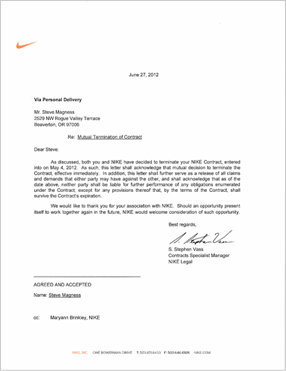
Prior to the publication of the initial stories, Magness provided ProPublica and the BBC with a “Mutual Termination of Contract” letter from Nike. The letter, dated June 27, 2012, starts: “Dear Steve, As discussed, both you and NIKE have decided to terminate your NIKE contract … As such, this letter shall acknowledge the mutual decision to terminate the contract, effective immediately.” The short letter ends with: “We would like to thank you for your association with NIKE. Should an opportunity present itself to work together again in the future, NIKE would welcome consideration of such an opportunity.” Emails from Salazar, provided by Magness, express “complete confidence” in him just one month earlier.
Termination Letter
Former Oregon Project assistant coach Steve Magness’s mutual termination letter with Nike. View document.
Yesterday, the Associated Press reported that the U.S. Anti-Doping Agency is investigating Salazar and that “more than a dozen witnesses have been interviewed and USADA is actively pursuing documents and other evidence from Salazar.”
Salazar was provided with an extensive list of questions a month prior to the initial ProPublica and BBC stories. He only answered a select group of them.
Salazar began today’s rebuttal by addressing an allegation about Salazar’s star athlete, Galen Rupp, that neither ProPublica nor the BBC made: “The claims that Galen has been on prednisone continuously since he was 15 are absolutely false.”
ProPublica and the BBC published a document showing that Rupp, who won the silver medal in the 2012 Olympics, had apparently taken prednisone during one time period when he was 16. The story did not report allegations of continuous use nor cite the age 15.
Salazar also said the article falsely reported that Rupp had received therapeutic use exemptions [TUE] by manipulating the TUE system and that he had received “numerous TUEs for multiple different treatments.” TUEs are exemptions that are granted to allow athletes to use otherwise restricted drugs or treatments. No such assertions were made in the story.
ProPublica and the BBC gave no accounting of TUEs given to Rupp in an elite running career that spans more than a decade. Salazar stressed that Rupp “has only received two TUEs in his running career since 2010.”
Salazar also noted that TUEs “are a rare occurrence in the Oregon Project.” No allegation about the prevalence of TUEs among Oregon Project athletes was made.
One of the most controversial elements of the ProPublica and BBC stories was an allegation that Rupp, Salazar’s longtime star, may have used testosterone while still in high school. Magness provided a photograph of a Nike Lab document that included a 2002 notation by a scientist that said Rupp was “presently on prednisone and testosterone medication.”
Prior to the initial stories, Salazar told ProPublica and the BBC that the notation was a mistake, and that Rupp was actually taking a legal dietary supplement meant to boost testosterone called Testoboost. In his current response, Salazar says that Rupp “does not recall exactly which supplement he took in 2002. It could have been Testoboost, Alpha Male, Tribex, or ZMA.” All are supplements meant to naturally boost testosterone.
Magness told ProPublica and the BBC that when he asked Salazar at the time to explain the document, Salazar called Loren Myhre, the scientist who made the notation, “crazy” and said he would get it clarified. Magness said he never did. Myhre died in 2012 from ALS.
In his response, Salazar questioned why Magness didn’t ask Myhre for an explanation at the time. Magness told ProPublica Wednesday that he didn’t know Myhre and that it was unfair to imply that it was his responsibility to investigate. Magness said there had been “no mention of the word ‘Testoboost.’”
“I came to my superior, Salazar, and asked for answers,” Magness said. “It would have been a simple clarification to make at the time by Salazar to contact Myhre, someone who he had worked with for at least a decade, to clear up the confusion. Salazar admits that he did not make this simple request, and instead blames it on me for not searching out Myhre.”
ProPublica contacted Mauro DiPasquale, the owner of Testoboost, who said that Salazar had recently contacted him in the hope that he would confirm that Rupp was taking Testoboost. DiPasquale told ProPublica he had no records regarding Salazar and Testoboost prior to 2004, and had no way of knowing whether Rupp was taking it in 2002. A number of Oregon Project athletes have told ProPublica they took Testoboost at various times. Adam Goucher says that he took Testoboost, but does not believe any of his lab documents indicated that he was taking testosterone medication. Salazar’s current response says that Rupp cannot remember what he told Myhre. “[Rupp] believes that he referred to his supplements as his testosterone supplements, stuff, pills or medication.”
Salazar’s response, which includes links to a number of redacted emails, does confirm claims made in the initial stories. Magness, for example, told ProPublica and the BBC that, before a race in 2011, Rupp used prednisone to treat asthma, but was denied a TUE. Rupp took the medication anyway, and Salazar sent Magness to the Mayo Clinic with a sample of Rupp’s urine to make sure it would not test positive for prednisone at the next race. Salazar’s account is consistent with the reports by BBC and ProPublica. As Magness said in the initial stories: “They did that to see if it tested positive.” Salazar also confirmed Magness’s contention that at times he hid prescription medications in books and magazines so that they would not be scrutinized by customs when he sent them internationally. In his response, Salazar said that he hid Nasonex for Rupp, who had a cough, in a paperback book and sent it to him in Dusseldorf, Germany. Nasonex is a glucocorticosteroid that is taken via an inhaled spray. Magness told ProPublica and the BBC that he received a hollowed-out paperback book that contained pills — not a nasal spray. Salazar had not previously responded to questions about whether he sent pills to Rupp in a hollowed-out book, and what those pills were.
Salazar also confirmed that he tested a testosterone gel on his sons to determine how much would trigger a positive test. Salazar said that Jeffrey Brown, a Houston endocrinologist who works with Oregon Project athletes, “set up the experiment” to determine whether an athlete could be sabotaged if a competitor rubbed testosterone gel on them surreptitiously at a race. Salazar did not respond previously when asked if the testing occurred and how it would be useful, but ProPublica and the BBC both previously reported that several members of the Oregon Project were told it was to counter sabotage.
Magness previously told ProPublica and the BBC that he felt that such a contention was “ludicrous … it was them trying to figure out how to cheat the tests … Furthermore, why are you putting testosterone on your son, who presumably has no medical need for it?”
In an interview, Brown said he did not prescribe a controlled substance for Salazar’s sons or other research subjects as part of an experiment. “No, absolutely not,” Brown said. “I didn’t do that, and would not do that. I would never do that.” He said that he was merely advising Salazar on how to conduct research on potential sabotage “in a hypothetical situation.” He said that Salazar’s exploration of potential testosterone sabotage was “admirable.” When asked whether Salazar was using his own prescription for testing on his sons, Brown declined to comment citing medical privacy laws.
Salazar disputed an account, corroborated by other sources, by former Oregon Project athlete Kara Goucher that Salazar had told her how he could coach Rupp to get a TUE for an IV infusion at the 2011 world championships. “Kara Goucher’s claim that someone can make a couple of statements to a doctor and get a TUE is absurd,” Salazar says in his statement. But Goucher’s contention was that Salazar explained the symptoms that Rupp would have to feign, including dehydration and an inability to drink.
Following the release of Salazar’s response, a former Nike employee who worked with the Oregon Project contacted ProPublica and said that he too had heard Salazar attempting to obtain an IV infusion for Rupp. “Galen was always ‘dehydrated’ right before a big race,” the former employee said. “Alberto was going crazy” when he was unable to obtain an IV for Rupp prior to a race in 2010, the employee added. A former member of the U.S.A. track and field medical staff also contacted ProPublica and said that Salazar became angry in 2008 when Rupp wasn’t given an IV at the Beijing Olympics in hot and humid conditions. Salazar and Rupp were presented with every allegation in the ProPublica and BBC stories in writing 27 days prior to publication, and neither responded at that time to questions about obtaining IVs.
ProPublica and the BBC also reported Goucher’scontention that in 2011 Salazar recommended she take the thyroid medicationCytomel that she was not prescribed — she was already prescribed a different thyroid hormone — in order to lose weight. Goucher provided ProPublica and the BBC with a pill bottle with the label ripped off, and “Cytomel” handwritten by, Goucher said, Salazar, and from a pharmacy near Salazar’s home. In his response, Salazar said that he never criticized Goucher’s weight and that Brown, Goucher’s endocrinologist, is the one who directed him to give Cytomel to Goucher at the world championships in Daegu, South Korea, in August 2011. The ProPublica and BBC accounts referred to an instance earlier in 2011, in March, prior to the Boston Marathon. “His story is a different timeline,” Goucher told ProPublica. “He’s trying to use Daegu to cover up Boston.”
Adam Goucher initially told ProPublica and the BBC that Brown “specifically told us that Kara didn’t need it and not to take, and that Alberto needs to stop trying to be the doctor.” In his response, Salazar said that the initial stories “notably” did not include comment from Brown. On Wednesday, Brown told ProPublica that he could not discuss individual patients but, “I would never, ever give somebody Cytomel for weight loss, ever.” As to the bottle, Brown said, “I don’t write on frickin’ bottles, and if it was mine, you wouldn’t be able to read it.” Asked whether he told Salazar to stop behaving like a doctor, Brown said: “I don’t remember” and added that, “most coaches, not just Alberto, tell our women athletes they are too fat. That is no reason to give Cytomel.”
ProPublica and the BBC also reported a claim by John Stiner, a masseuse who formerly worked with Oregon Project athletes, that Salazar had him ship testosterone to him and claimed it was for his heart — Salazar had a heart attack the prior year--an explanation Stiner doubted. In his response, Salazar said that he has a prescription for Androgel, but denied saying it was for his heart. In his response, Salazar said that the testosterone was for “preserving my energy,” and published emails showing his discussions with physicians about it. On Wednesday, Stiner told ProPublica: “I told 100% the truth. I’ll take 20 lie detector tests. Of course he said I’m lying.” Neither ProPublica nor the BBC contended that Salazar was not prescribed testosterone, and Salazar did not respond to questions regarding the reason he would be prescribed testosterone. Paul Thompson, Director of Cardiology at The Athletes Heart Program and Cardiovascular Research at Hartford Hospital, and a former Olympic Trials marathon qualifier, told ProPublica that he “would try very hard never to prescribe testosterone” for someone with heart problems, due to evidence that it could increase the risk of heart attack. Thompson was commenting generally, not with respect to Salazar’s medical conditions. Salazar’s response also addressed whether athletes were urged to take prescription medications they didn’t need. He said “athletes are not pushed to take medications.” Numerous athletes told ProPublica that they were encouraged to take medications that they hadn’t taken before, or in a manner not consistent with what a doctor recommended. Salazar noted that only eight of the 55 athletes he has coached have been diagnosed with asthma. One of the allegations that ProPublica reported was that athletes who were not diagnosed with asthma were still offered inhalers.
In one email Magness provided to ProPublica, Salazar noted that an inhaler would be sent back to an athlete who was prescribed it after it had been borrowed in case another athlete needed it. In the email, Salazar wrote: Magness “is going to send you your inhaler, we never needed it for that Nike athlete. Thx for bringing it!”
Salazar said in his response that “asthma medication has been proven not to be performance enhancing.” There is some evidence that albuterol inhalers acutely improve muscle performance — but not aerobic endurance in non-asthmatics — and studies suggest that corticosteroids can increase oxygen uptake and are a doping risk. Following the initial ProPublica and BBC reports, a number of athletes and former athletes contacted ProPublica and expressed concern about how Salazar had recommended they use asthma-treating corticosteroids. One of those athletes is Lauren Fleshman, who spoke openly about her misgivings when Salazar told her to use a corticosteroid in a manner that was contradicted by her doctor. “Turning illness into an advantage was not right,” Fleshman said.
Salazar also said in his response that Magness “focused on one female runner” and that he told Magness that “he had to make it clear to everyone by his actions that he was not having a physical relationship with an Oregon Project athlete.” Prior to publication of the ProPublica and BBC stories, both Magness and former Oregon Project athlete Jackie Areson told ProPublica and the BBC that they became close while working at the Oregon Project and did have a relationship after both parted from the Oregon Project. At that time, Areson also told ProPublica that Salazar distributed prescription painkillers “like it was candy” and that she “never let [Salazar] massage me because I knew he had the testosterone cream and didn't trust him.” In a follow up, Areson said that it was not “until the start of 2013 that we had a relationship, well after we had moved to Houston.”
Read more of our reporting on Alberto Salazar and doping allegations.

Widespread Problems With Group Home Agency Prompt City to Cut Ties
Three weeks after three teens allegedly raped a woman after fleeing a group home in Brooklyn, New York City has ended its multimillion-dollar contract with the nonprofit social services agency that ran the home.
The development, jointly announced Wednesday by the city and the agency, came after authorities uncovered management problems at other group homes operated by the organization, known as Boys Town.
Boys Town had signed a $6.4 million deal with the city to oversee troubled youngsters as part of an experimental program launched in 2012. The initiative, known as Close to Home, calls for juvenile offenders to be held in group homes rather than in the upstate youth prisons that had been plagued by violence and allegations of sexual abuse. The idea was that the children would be more effectively treated if they were kept nearer to their families and received therapeutic services in less restrictive settings. The program requires that the homes be locked and equipped with alarms.
Earlier this month, three 16-year-old boys from a Boys Town home in Park Slope were arrested and charged with beating, robbing and raping a woman in Manhattan’s Chinatown neighborhood. A worker at the home was later charged with having falsified records meant to show the boys were being properly accounted for and supervised. The arrests prompted Boys Town to immediately stop accepting new children at the Brooklyn residence.
According to an official briefed on that investigation, the city’s Administration for Children’s Services dispatched a team that conducted nine unannounced site visits in Boys Town’s four Close to Home facilities during the week immediately following the alleged rape.
“The results were troubling and revealed an inconsistent ability to comply with Close to Home requirements,” said the official, who was not authorized to speak by name about the investigation. “Supervisors were unable to ensure that the sites were secure and properly monitored.”
“Given the horrifying assault as well as Boys Town’s history of struggling to comply with Close to Home regulations, ACS and Boys Town jointly agreed to end the contract,” the official said.
In announcing the end of its contract with the city, Dan Daly, Boys Town’s director of youth care, defended the agency’s reputation.
“Boys Town has consistently been committed to serving youth in New York and across the country,” Daly said in a statement, adding that the agency will continue to provide other services in the city. “We have decided to shift our work toward what we do best.”
In the same statement, Gladys Carrión, commissioner of ACS, voiced support for the agency.
“New York City has a long standing partnership with Boys Town. We appreciate all of Boys Town’s hard work,” she said.
Boys Town is the third non-profit agency to end its Close to Home contract with the city in the two years the program has been underway. In June 2013, a 17-year-old ran away from a Staten Island home and allegedly stabbed a man to death in Queens. The home, run by the non-profit New York Foundling, was shut down by ACS. In early July 2013, New York Foundling voluntarily withdrew from its contract with the city.
A spokesperson for New York Foundling would not respond to questions on the matter, pointing instead to a press statement issued at the time.
“At this time, we have made a determination that the fit of the Close to Home program with our other community and evidence-based programs is not optimal, and so we have voluntarily decided to end our participation in the program,” said Bill Baccaglini, the president and chief of executive of New York Foundling. “In no way should the recent tragic incident be interpreted as an indictment of the Close to Home program, a very smart and most welcome policy shift in the treatment of juvenile delinquents.”
Another home on Staten Island run by St. Vincent’s Services agreed to have its city contract revoked due to issues with runaways. A spokesperson for St. Vincent’s did not immediately respond to comment for this article.
The Boys Town home in Brooklyn had come under scrutiny from ACS before the alleged rape this month. In January 2014, children from the facility were running away and getting involved in violent incidents, prompting ACS to put the home under what is known as “heightened monitoring status,” wherein inspectors visit the home more regularly and attempt to tighten security measures.
The city official said that Boys Town satisfied the regulators’ requests sufficiently enough to remove the home from the increased monitoring.
Boys Town serves more than 1,700 children and families involved in the New York City criminal and family justice system every year.
Following the arrests earlier this month, the city Department of Investigation said it would conduct a broader investigation of the Close to Home program. A person familiar with the evolving investigation said DOI had recently directed officials at various Close to Home facilities to preserve any and all documentation concerning their operations.
ProPublica reported two weeks ago that runaways from Close to Home facilities had gone down of late. In 2013, there were 740 AWOLs, while in 2014 there were 363. In that time span, the program increased the number of children it served from 583 to 707.
Help us investigate: If you have experience with or information about group homes, email Joaquin.Sapien@propublica.org.
Related stories: Read about a group home in California that came undone and what that means for the state’s chance at reform. And see more of ProPublica’s reporting on group homes.

VIDEO: The lab hoping to make stronger metals


Are You a Vietnam Veteran? Help Us Investigate the Impact of Agent Orange


ProPublica and The Virginian-Pilot are exploring the ways children of Vietnam veterans may be affected by a parent's exposure to Agent Orange.
The Department of Veterans Affairs acknowledges that direct exposure to Agent Orange and other defoliants may lead to negative health consequences for veterans. Some veterans’ service organizations, including the Vietnam Veterans of America, have expressed concern that exposure has also led to health issues in the children of veterans.
Are you a Vietnam veteran? You can help us learn more about this issue by completing the short survey below, which includes questions about your service, family and health. Please answer as completely as you can. Your personal information will not be shared with others without your permission, but reporters plan to aggregate statistical information and publish an overview about the results of the survey, without identifying specific individuals.
Are you the family member of a veteran? Please complete our survey for family members here. The more veterans we hear from, the better we can understand this issue. We hope you’ll consider responding or sharing this survey with other veterans. Thank you!

